Introduction
We will discuss 3D printing in dentistry and its impact on dental prostheses and restorations. To begin, 3D printing has emerged as one of the most revolutionary technologies in the field of dentistry, transforming traditional manufacturing methods into faster, more precise, and more accessible processes. This innovation has not only redefined quality standards in dental prosthetics and restorations, but has also enabled laboratories and clinics to optimize production times and reduce costs.
In this article, we will explore the impact of 3D printing on modern dentistry, highlighting its applications in dental prosthetics, its benefits for both patients and professionals, and practical tips to achieve optimal results in the printing process.
Main applications of 3D printing in dentistry
1.1. Customized dental prostheses
Today, 3D printing allows us to manufacture dental prostheses tailored to the specific needs of each patient, ensuring a perfect fit and greater comfort. Among the different types of rehabilitations that can be produced with 3D printing resins are:
- Complete denture bases: manufactured with biocompatible resins, offering superior anatomical precision.
- Prosthetic teeth: produced with materials that mimic the translucency and color of natural enamel.
For these types of rehabilitations, it is important to perform a detailed intraoral scan to obtain an accurate digital model that optimizes prosthesis fabrication. Alternatively, a physiological impression of the tissues can be taken using traditional impression materials, then scanned from the resulting gypsum model to work on the STL file for design and printing.
1.2. Dental restorations
One of the greatest advantages of 3D printing is the reduction in chair time, as it enables immediate restorations. 3D printing is ideal for producing restorations such as crowns, bridges, and veneers with speed and precision. High mechanical strength and natural aesthetics are essential characteristics of these materials, along with biocompatibility.
In these cases, it is common to combine high-strength resins with CAD/CAM designs to create precise and durable restorations.
1.3. Surgical guides and diagnostic models
3D printed models are essential for planning complex procedures, such as dental implant placement or bone reconstructions. For surgical guides, it is recommended to use translucent resins that allow clear visualization of surrounding tissues and adjacent teeth.
These cases require excellent stability and the ability to be sterilized in an autoclave without dimensional deformation, fractures, or discoloration that could compromise the integrity of the guide. High-resolution printers are essential to ensure accuracy.
Benefits of 3D printing in dentistry
2.1. Reduced production times
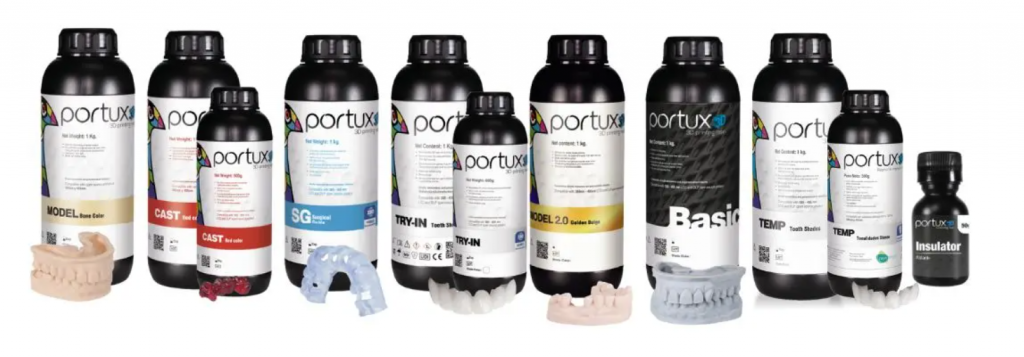
Additive manufacturing makes it possible to complete tasks that previously required weeks in just hours or days. For example, temporary prostheses can be printed in a single session using 3D Try-In resin, designed for functional testing.
2.2. Lower costs and reduced material waste
Unlike traditional methods, 3D printing uses only the material necessary to produce the prosthesis or restoration.
2.3. Advanced customization
Each print is based on patient-specific data, improving treatment precision and comfort.
3D printing process in dental prosthetics
3.1. Scanning and digital design
The process begins with an intraoral scan or a digitized traditional impression. The design is then created using CAD software.
It is essential to properly adjust design parameters to optimize occlusal contact points and marginal fit.
3.2. Material selection
Choosing the correct material is critical to achieving the desired results:
- Photopolymer resins: ideal for temporary prostheses or diagnostic models.
- Hybrid or ceramic materials: suitable for definitive restorations.
It is important to ensure that resins are compatible with your printer. Otherwise, the resin must be properly parameterized. Additionally, materials must meet required biocompatibility and quality standards.
3.3. Printing and post-curing
Print quality depends on factors such as printer resolution and curing parameters.
Always verify printer calibration before each job and perform post-curing according to the manufacturer’s specifications to maximize material strength.
3.4. Finishing and final adjustments
After printing, adjustments and polishing are carried out to ensure both aesthetic and functional results.
Challenges and considerations in dental 3D printing
4.1. Technical limitations
Although 3D printers are becoming more accessible, high-end dental equipment still represents a significant investment.
4.2. Learning curve
Dental technicians must be trained in CAD design and software management to fully leverage 3D printing capabilities.
Conclusion
Adopting these advanced techniques and next-generation materials not only improves the patient experience but also positions dental laboratories as leaders in quality and efficiency. The present and future of dentistry lie in personalization, biocompatibility, and the application of digital technologies to ensure more precise and effective prosthetic dentistry.
We invite you to follow us on all our information channels and social media, especially on our YouTube channel, where we share product videos and workflow techniques.
3D printing is redefining the landscape of modern dentistry, enabling dental professionals to deliver customized, high-quality solutions in record time. From full prostheses to aesthetic restorations, this technology enhances not only laboratory efficiency but also the patient experience.
To maximize its benefits, it is essential to invest in quality equipment, select appropriate materials, and train technical teams in the latest advancements. By doing so, dental laboratories can position themselves at the forefront of the industry and fully leverage the possibilities of additive manufacturing.
We invite you again to follow us on our information channels, social media, and especially on our YouTube channel, where we provide product demonstrations and workflow techniques.
References
Coronel, M. (2023). Impact of 3D Printing in Prosthetic Dentistry. Conference at the National Congress of Dental Technicians.
Fonollosa, J. M. (2022). Dental Prostheses and Restorations in the Digital Era. Dental Innovation Journal.
Dawood, A., Marti Marti, B., & Sauret-Jackson, V. (2015). 3D Printing in Dentistry. British Dental Journal, 219(11), 521–529.
Revilla-León, M., & Özcan, M. (2020). Additive Manufacturing Technologies in Prosthodontics: Where Do We Currently Stand? A Critical Review. Journal of Prosthodontics, 29(2), 97–106.
Photopolymer Resins and Their Application in Dentistry. (2023). International Journal of Digital Dentistry.
TPDE. DANIEL ANDRÉS ZÁRATE A.