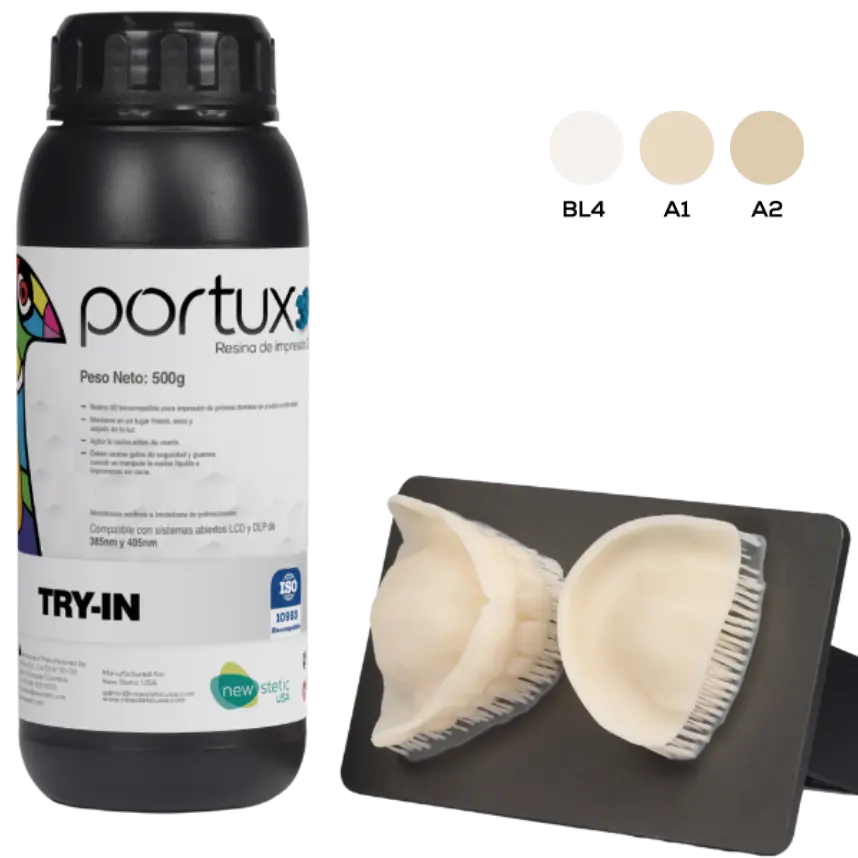
Elaborated by: TPDE. DANIEL ANDRÉS ZÁRATE A.
On this occasion, I will talk about 3D printing from the perspective of parameterization and its importance. Dental 3D printing has radically transformed the way laboratories and clinics produce surgical guides, study models, temporary restorations, and high-precision prostheses. However, the success of each print does not depend solely on the quality of the resin; it depends equally—or even more—on that resin being correctly parameterized in the printer that processes it.
Portux 3D, the line of high-precision resins developed to optimize the digital dental workflow, has been formulated with engineering standards that are only fully expressed when the printing parameters are appropriate. Incorrect exposure, a poorly calibrated layer, or improper curing time can turn an excellent resin into a mediocre result, leading to rework, financial losses, and in the worst cases, clinically unsuitable parts.
In this article, I explain what parameterization is, why it is critical, the most common mistakes, and how Portux 3D resins are supported by specific technical protocols for more than 30 printer models on the market.
Proper parameterization of Portux 3D resins in each printer ensures structures with maximum precision, superior finish, and full utilization of the material’s properties, avoiding rework and ensuring reliable results from the very first print.
1. What does it mean to parameterize a resin in an LCD/DLP printer?
Photopolymerization printers, whether LCD (Masked Stereolithography) or DLP (Digital Light Processing), work by projecting ultraviolet light onto layers of liquid resin to selectively polymerize them. This process involves multiple variables that must be precisely configured for each combination of resin and equipment, as described below:
- Layer exposure time (in seconds): controls how long the light is applied to each resin layer.
- Layer thickness (in micrometers, µm): defines the vertical resolution of the part. Portux 3D resins can operate at 50 µm or 100 µm depending on the application.
- Bottom layer exposure time: the first layers require longer exposure to properly adhere to the build platform.
- Lift speed (platform raising and lowering speed): affects the mechanical stress on already solidified layers.
- Light source wavelength: Portux 3D resins are compatible with printers operating between 385 nm and 405 nm.
It is important to understand that each of these factors interacts with the chemical formulation of the resin. Changing one without adjusting the others can result in parts with dimensional deformation, fragility, overcuring, or undercuring.
2. Why aren’t the printer manufacturer’s generic parameters enough?
A common mistake in laboratories and clinics starting with 3D printing is assuming that the printer’s default parameters will work with any resin. This assumption is incorrect and can be costly.
Each resin has a unique photopolymerization curve, determined by its formulation of monomers, photoinitiators, and additives. For example, Portux 3D Temp resin, indicated for temporary restorations, does not have the same photochemical behavior as Portux 3D SG, formulated for sterilizable biocompatible surgical guides. Nor does it behave like Portux 3D Cast, designed for precision casting, or Portux 3D Model, intended for high-resolution study models.
Using incorrect parameters leads to specific consequences:
- Overcuring: excessive exposure that hardens unwanted areas, erases fine details, and produces oversized parts.
- Undercuring: insufficient curing that results in fragile, porous parts or parts that detach from supports prematurely.
- Dimensional deformation: fitting errors in models, crowns, or guides that require reprinting.
- Build platform adhesion failure: total print loss and possible damage to the vat’s FEP film.
- Compromised mechanical properties: suboptimal strength, flexibility, and hardness, which in biocompatible applications may have clinical implications.
Remember: Portux 3D biocompatible resins (Temp, Try-In, SG) are certified under ISO 10993 for medical devices. Their safety properties are only guaranteed if the printing and post-curing processes are carried out correctly according to the official protocol.
3. The Portux 3D solution: validated parameters for more than 30 printers
Recognizing that parameterization is the most critical link in the digital dental workflow, Portux 3D offers on its web platform a comprehensive and up-to-date database of printing profiles for each resin in its portfolio, combined with the most widely used printer models on the market.
Brands and printers with validated and available parameters at portux3d.com/printers include equipment from Elegoo (Saturn and Mars series), Anycubic (Photon Mono series), Phrozen (Sonic series), Creality (Halot), Flashforge, Shining 3D, Straumann Rapid Shape, Zirkonzahn, Uniz, and more.
For each resin–printer combination, the parameter file specifies all the values required by the slicer with precision, eliminating the trial-and-error process that consumes time, resin, and money.
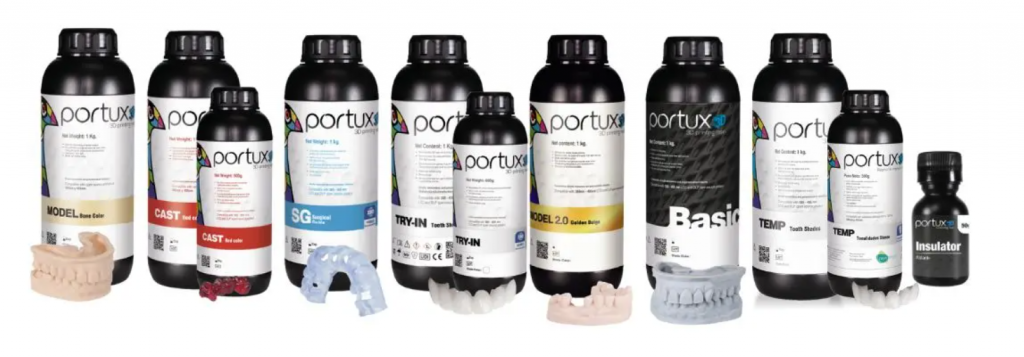
Portux 3D resins and their main applications:
| Resin | Application | Intraoral Use / Certification |
|---|---|---|
| Portux 3D Model / 2.0 | Study and working models | No — Laboratory use |
| Portux 3D Cast | Precision casting / lost wax | No — Laboratory use (testing only) |
| Portux 3D Try-In | Aesthetic and functional try-ins | Yes — ISO 10993 |
| Portux 3D Temp | Temporary restorations | Yes — ISO 10993 |
| Portux 3D SG | Surgical guides (autoclavable) | Yes — ISO 10993 |
| Portux 3D Basic | General-purpose printing | No — Laboratory use |
| Portux 3D Insulator | Insulation / technical applications | No — Technical use |
4. Parameterization protocol: what to do if my printer is not on the list?
Portux 3D also offers a downloadable Parameterization Protocol, designed so laboratories can determine optimal parameters on any compatible LCD/DLP printer (385–405 nm) through a systematic testing process using the Portux scoring test piece.
This protocol allows you to:
- Determine the exact exposure time for each resin on the user’s specific equipment.
- Validate layer adhesion, dimensional accuracy, and surface finish.
- Avoid material waste during the initial adjustment stage.
- Document validated parameters for reproducibility.
The STL file for the Portux scoring test piece is available for free download at portux3d.com, and together with the PDF protocol, forms a technical reference guide for any professional seeking maximum resin performance.
5. Post-curing: the step that completes parameterization
It is very important to understand that parameterization does not end with printing. Post-curing is the process in which the printed part receives additional UV light energy to complete polymerization and achieve its final mechanical properties. Insufficient post-curing leaves the part under-polymerized, fragile, and potentially toxic for intraoral use. Excessive curing can lead to brittleness due to over-polymerization.
On the Portux 3D website, you can find all recommended post-curing protocols for each resin in the Post-Curing section, ensuring professionals have all the necessary information in one place to guarantee the quality and safety of the final result.
Important: The biocompatibility of Portux 3D Try-In, Temp, and SG resins can only be guaranteed if the manufacturer’s printing, cleaning, and curing protocols are strictly followed. Selecting the correct printing profile is an essential part of this protocol.
6. Compatibility with CAD/CAM design software
Portux 3D resins are compatible with any digital design workflow. Professionals can use their preferred software—3Shape, Exocad, BlueSkyBio, or others—to design their parts. Design parameters are defined by the dental technician according to the clinical work order, while printing parameters are provided by the Portux 3D resin protocol.
This flexibility makes Portux 3D a solution that integrates seamlessly into the laboratory’s technological ecosystem without compromising result quality.
7. Technical support: guidance at every step of the process
New Stetic, the company behind Portux 3D, provides a robust technical support system that includes updated technical documentation (technical data sheets, safety data sheets, and instructions for use), a web platform with printing and post-curing protocols, articles and handling tips, and assistance via chat, phone, and in-person visits depending on the geographic area.
This means that professionals adopting Portux 3D are not alone during the setup process. The technical team is available to support everything from selecting the correct printing profile to the final polishing protocol, ensuring that every printed part meets the highest clinical quality standards.
Precision begins before printing.
I hope this article is very helpful and that you enjoyed it. In conclusion, high-quality dental resin is a necessary condition for achieving superior clinical results, but it is not sufficient on its own. Proper printer parameterization is the bridge between the intrinsic properties of the material and its real-world performance in the dental workflow. Portux 3D has built a complete ecosystem to make that bridge solid, reproducible, and accessible: validated profiles for more than 30 printers, a parameterization protocol for unlisted equipment, resin-specific technical documentation, and continuous professional support.
When the right resin meets the right parameters, the result speaks for itself: dimensional accuracy, superior finish, and the confidence that every restoration meets the highest standards from the very first print.
Is your printer already configured with Portux 3D parameters? Check the validated profiles for your equipment at portux3d.com/printers or download the parameterization protocol to start printing with maximum confidence.